
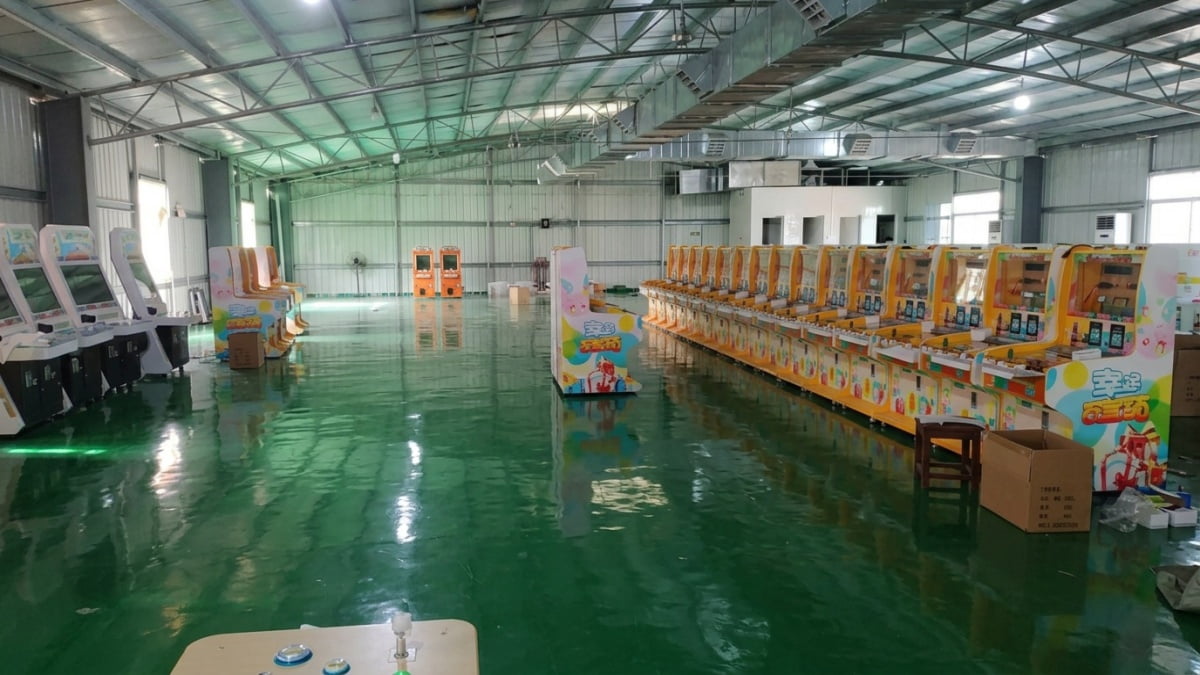
A commercial game room can look ready to open while still being difficult to operate. Machines may fit the floor plan but block a service door, crowd a customer aisle or place too much equipment on one electrical circuit.
These problems are easier to correct before the cabinets are unpacked and connected. Once the room is filled with machines, stools, payment readers and power cables, even a small layout change can take hours.
For venue owners, the priority is reliable daily operation. Distributors need a clean installation and handover process. Repair teams need practical access to the parts they will eventually inspect or replace. The checks below cover the work that matters most between delivery and opening day.
Check the Delivery Route Before Unloading
Use the packed dimensions, not only the finished machine size. Measure the unloading point, entrance, lift, corridor, stairs and the tightest corner between the delivery vehicle and the final position.
Large multiplayer machines may require the control panel, seating section or upper decoration to be removed before entry. Confirm this with the supplier in advance and make sure the correct tools and reassembly instructions arrive with the equipment.
Photograph the outer packaging before opening it. Check cabinet corners, screens, control panels and accessory cartons as the machine is unpacked. Overseas buyers can refer to our arcade machine shipping guide for more detailed arrival checks.
Confirm the Electrical Plan Before Placing Machines
Record the voltage, frequency, plug type and rated power of every machine model. The IEC World Plugs reference lists the electrical systems used in different markets, but the final installation should still be checked by a qualified local electrician.
A basic load estimate helps during planning. Ten machines rated at 500 W represent 5,000 W of connected load. At 220 V, the theoretical current is about 22.7 A. This is only an estimate—not a circuit design. Start-up demand, cable capacity, protective devices, operating margin and local regulations still need to be considered.
Avoid temporary adapters and unlabelled extension leads. Divide the floor into practical circuit groups and label each group clearly. When a fault occurs later, staff should be able to isolate one section without switching off the entire venue.
Plan the Operating Footprint, Not Just the Cabinet Size
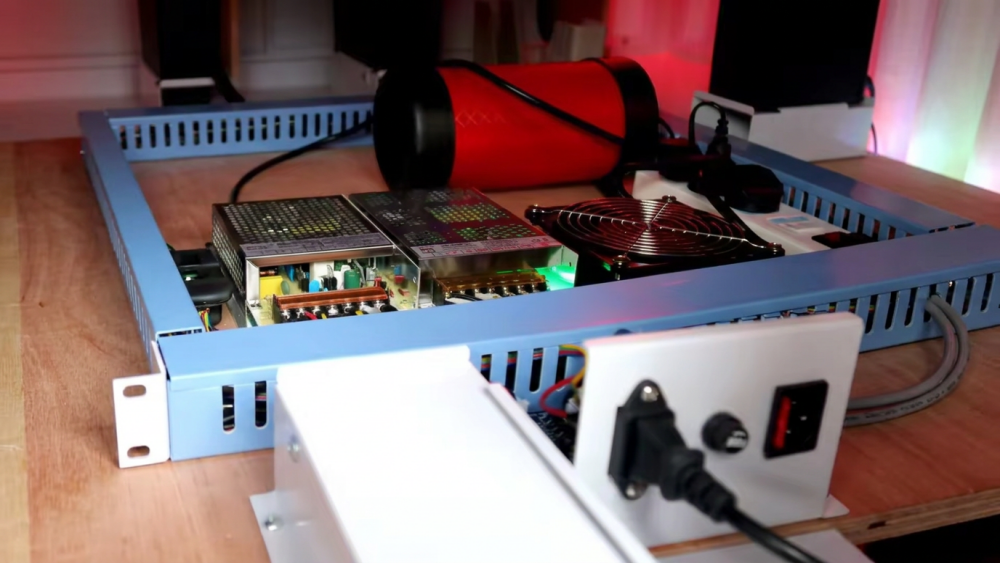
The cabinet footprint does not show how much floor space the machine really needs. Add space for players, stools, passing customers, ventilation and opening the service doors.
Machines that require regular access should not be positioned where another cabinet must be moved before the rear panel can open. Power switches, card readers, service locks and control panels should remain reachable without blocking the customer route.
Accessible routes, emergency exits and fire clearances must follow local requirements. The aim is not to fit the maximum possible number of machines into the room. It is to use the floor space without making everyday operation and maintenance harder.
Our commercial arcade machine buying guide explains how to balance equipment mix, customer type and available space.
Commission the Payment System Before Final Testing
A machine tested at the factory with a standard coin signal is not automatically ready for the venue’s card reader or central payment system.
Confirm the reader voltage, signal method, mounting position and credit value. On multiplayer equipment, test every station separately. One incorrect connector or credit setting can remain unnoticed when staff only check the first player position.
After changing payment or game settings, restart the machine and confirm that the settings are retained. For networked payment systems, check that each transaction is recorded against the correct cabinet or player position.
Run a Real Pre-Opening Test
Do not treat the title screen as proof that the machine is ready. Start each cabinet from cold, allow it to reach normal operating temperature and test the functions a customer will actually use.
- Screen image, sound, lighting and cooling fans.
- Every button, joystick and player position.
- Coin, card or other payment input.
- Language, difficulty and credit settings.
- Restarting and retention of saved settings.
- Stable operation without resets or screen faults.
Record any adjustment made during installation. Months later, a technician should not have to reconstruct the original configuration from old messages or memory.
Create a Record for Every Machine
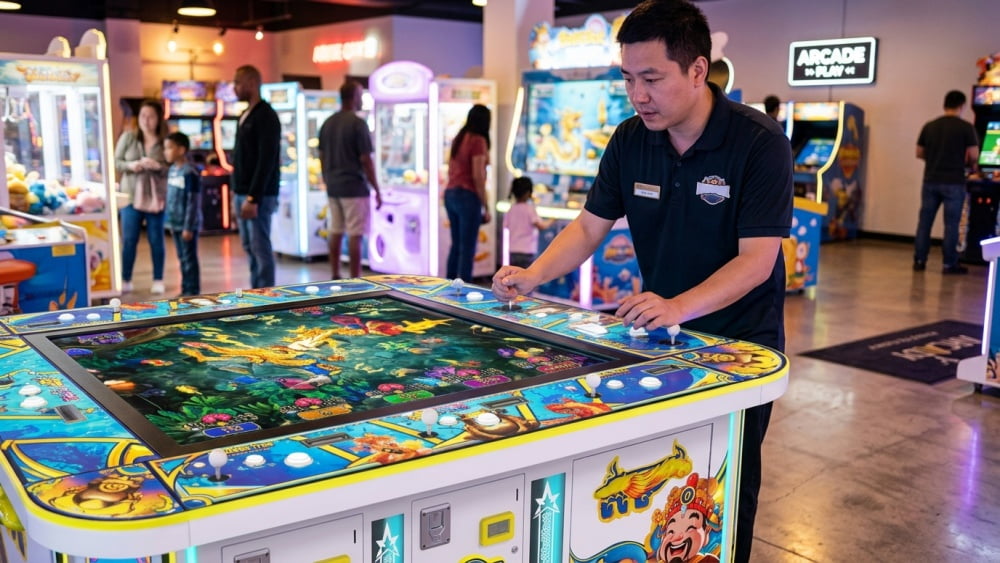
Assign each cabinet an internal machine ID. Record the model, serial number, PCB and software version, player count, voltage, payment settings and circuit location. Keep wiring diagrams, manuals, installation photos and factory test videos in the same folder.
Distributors should pass this information to the venue during handover. Repair teams should also identify which machines share common buttons, power supplies, payment modules and I/O boards.
Our arcade machine spare-parts inventory guide provides a practical starting point for organizing routine and machine-stopping parts.
Industry Insight
A good installation does more than prepare the room for opening day. It creates the operating standard the venue will use for years.
Consistent machine IDs, labelled circuits, common credit settings and recorded software versions make future faults easier to isolate. A cabinet that cannot be serviced without moving two other machines may appear to save floor space, but it converts that saving into future downtime.
A NIST manufacturing maintenance study found that the surveyed group using more preventive and predictive maintenance had 52.7% less unplanned downtime and 78.5% fewer defects than the group relying more heavily on reactive maintenance.
These figures are not arcade-industry statistics, but the operating principle is relevant: equipment is easier to support when its configuration, condition and likely spare-part needs are documented before a failure occurs.
Final Thoughts
A reliable commercial game room setup begins with delivery access and electrical planning, followed by serviceable machine placement, payment-system commissioning and a complete opening test.
For venue owners, this reduces avoidable disruption. For distributors and repair teams, it creates a clearer handover and a much better starting point for future maintenance.
Need Factory Direct Fish Game Solutions?
Contact FUSEN for fish game machines, PCB kits, cabinets, OEM/ODM customization, and long-term technical support.
Get Factory Quote