

An arcade machine power supply can look normal and still cause problems under real operating load. Random restarts, screen flicker, unstable PCB operation or inconsistent payment response are all reasons to check the power system early.
For arcade operators, distributors and repair buyers, replacing a power supply is not simply a matter of finding the same wattage. Voltage, output capacity, wiring, heat, connectors and full-machine testing all need to match the actual cabinet.
Before buying a replacement, these six checks can help reduce wrong-part orders and repeat repairs.
Confirm the Input Voltage First
Start with the machine and destination market. Input voltage, frequency, plug type and grounding should be confirmed before comparing other specifications.
The IEC World Plugs reference provides country-level information on mains voltage, frequency and plug types. For export orders, this is useful background, but the final machine configuration should still be confirmed with the supplier.
For example, our 6 Player Fish Hunter Arcade Cabinet is available in 110V/220V configurations. The required voltage should be locked before shipment rather than assumed from the country alone.
Do Not Choose by Wattage Alone
Wattage matters, but it does not tell the whole story. An arcade cabinet may need to power the PCB, I/O board, monitor, lights, fans, speakers and payment system at the same time.
The output voltages and available current therefore need to match the machine configuration. A power supply may pass a short startup test and still become unstable after the machine has been running under heavier load.

Match the Wiring, Connectors and Mounting
A power supply can have the correct electrical rating and still be a poor replacement if the terminals, connectors or mounting space do not match the cabinet.
Before ordering, send clear photos of the old power-supply label, terminals, wiring harness and installation area. If the machine has been repaired or modified before, the current wiring may not match the original factory configuration.
Leave Enough Load and Heat Margin
Commercial arcade machines may run for long periods inside enclosed cabinets. The monitor, PCB, lighting and power supply all generate heat, while airflow may be limited.
RECOM’s thermal and load derating guide explains that higher ambient temperatures can reduce available output and that ignoring thermal limits can contribute to overheating, shutdown or shorter component life.
For arcade buyers, the practical point is simple: avoid operating continuously at the edge of the power supply’s capacity and make sure the cabinet has reasonable ventilation.
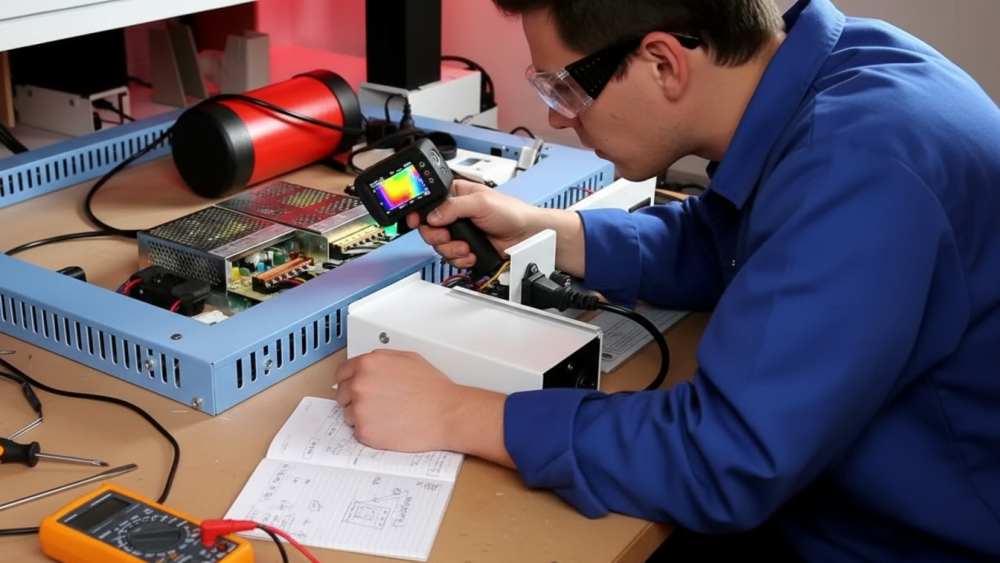
Test It With the Complete Machine
A bench test cannot show everything. What matters is how the power supply performs after the PCB, monitor, controls, lighting, sound and payment system are connected.
The Dragon & Phoenix Fish Table PCB Kit, for example, is supplied as a matched system with the main PCB, keypad, power supply and connection parts. This is a useful reminder that the power supply should be checked as part of the complete operating system rather than in isolation.
For complete-machine orders, ask for a testing video showing the actual machine running before shipment.
Make Future Replacement Easy
For repair buyers, the cheapest power supply is not always the lowest-cost repair. If the replacement needs rewiring, does not fit the cabinet or cannot be sourced again later, downtime can become more expensive than the part itself.
Operators running several machines should record the power-supply model, input and output specifications, connector arrangement and the cabinets that use it. Distributors can also standardize common compatible models where practical.
Six Checks Before Ordering
| Check | What to Confirm |
|---|---|
| Input | Voltage, frequency, plug and grounding |
| Output | Required voltage rails and current capacity |
| Compatibility | Wiring, terminals, connectors and mounting space |
| Load & Heat | Operating margin and cabinet ventilation |
| Testing | Performance with the complete machine connected |
| Replacement | Future availability of the same compatible model |
Signs the Power Supply Is Worth Checking
- The machine restarts during gameplay.
- The monitor flickers or goes black intermittently.
- The PCB becomes unstable after longer operation.
- LED lighting behaves abnormally.
- Coin acceptor or card reader response becomes inconsistent.
- The cabinet becomes unusually hot.
These symptoms can also be caused by the PCB, monitor, I/O board or wiring, so they are not proof of a failed power supply. But when several systems become unstable at the same time, checking the power system early makes sense.
What Should You Send Before Ordering a Replacement?
- Machine model and full cabinet photo.
- Clear photo of the old power-supply label.
- Input and output specifications.
- Terminal and connector close-ups.
- Photos of the existing wiring.
- A short video showing the fault.
Industry Insight: Power Margin Is Cheaper Than Repeat Downtime
A power supply is not the component that sells an arcade machine, but it can become one of the components that determines how often technicians need to open the cabinet.
For operators and distributors, the better purchasing decision is usually a power supply with the correct specification, enough operating margin, compatible wiring and stable repeat availability — not simply the lowest purchase price.
Final Thoughts
Before buying an arcade machine power supply, check more than wattage. Confirm input voltage, output capacity, wiring, connectors, heat conditions, full-machine performance and future replacement availability.
Fusen supplies power supplies, PCBs, I/O boards, wiring and other replacement parts for commercial arcade machines. For repair and complete-machine orders, matching the power supply to the actual machine configuration before shipment is one of the simplest ways to reduce avoidable downtime.
Need Factory Direct Fish Game Solutions?
Contact FUSEN for fish game machines, PCB kits, cabinets, OEM/ODM customization, and long-term technical support.
Get Factory Quote