
The cheapest arcade machine is not always the least expensive machine to own.
A quotation shows the purchase price. It may not show freight, local modification, spare parts, technician time, downtime, or the cost of supporting an unusual configuration several years later.
For venue owners and distributors, the better comparison is total cost of ownership: what it takes to put the machine into service and keep it operating reliably.
The Purchase Price Is Only the Beginning
Life-cycle costing compares the initial investment with future operating, maintenance, repair, and replacement costs. The U.S. General Services Administration describes this approach as a way to identify options with the lowest total ownership cost.
For an arcade machine, the first calculation should include the machine, packaging, freight, insurance, import charges, local delivery, unloading, and installation.
A large cabinet may also require lifting equipment, wider access doors, partial disassembly, or additional labour. These costs can quickly remove the advantage of a lower factory price.
Before ordering, ask for packed dimensions, gross weight, loading method, package quantity, and installation requirements. Our arcade machine shipping guide covers the main checks for overseas buyers.
Local Compatibility Changes the Final Cost
An imported machine must match more than the local wall socket.
Voltage, frequency, plug type, payment signal, credit settings, language, screen output, software version, and installation conditions should all be confirmed before shipment.
When these details are left unresolved, the buyer may need to replace parts, modify wiring, reconfigure software, or hire a local technician after arrival. None of these expenses appears in the original machine price, but all belong to the purchase.
Downtime Can Cost More Than the Failed Part
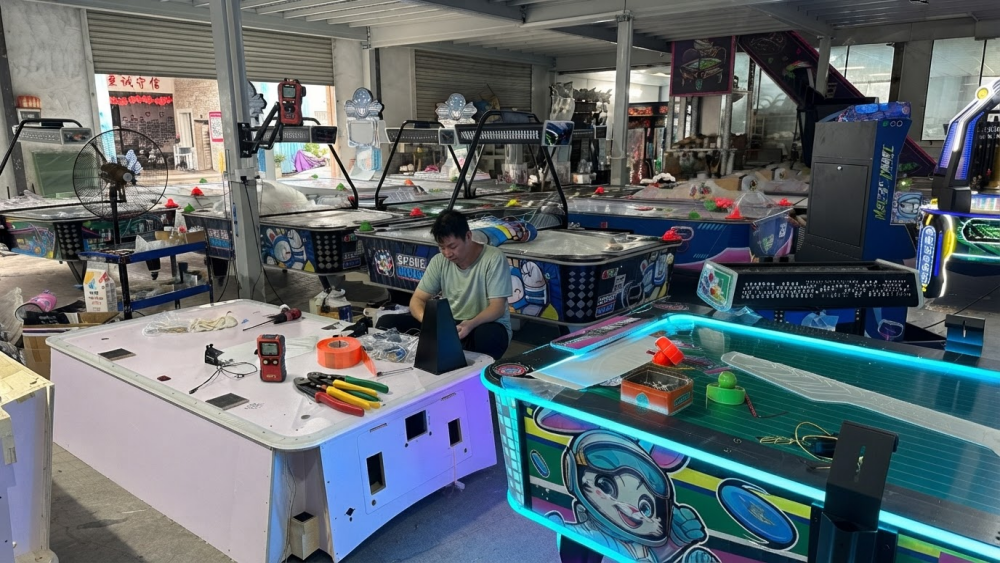
A failed button, joystick, power supply, or I/O board may be inexpensive. The larger cost can be the time spent diagnosing the problem, waiting for the correct part, arranging express delivery, and keeping the machine out of operation.
A NIST study of manufacturing machinery found 52.7% less unplanned downtime among surveyed firms relying more heavily on preventive and predictive maintenance than firms relying more on reactive maintenance.
This is not an arcade-machine failure statistic. The practical lesson is still relevant: planned inspections, common spare parts, wiring records, and clear technical support reduce the time needed to return equipment to service.
Our article on arcade machine downtime explains why spare-parts availability matters in commercial operation.
Configuration Continuity Is a Hidden Asset
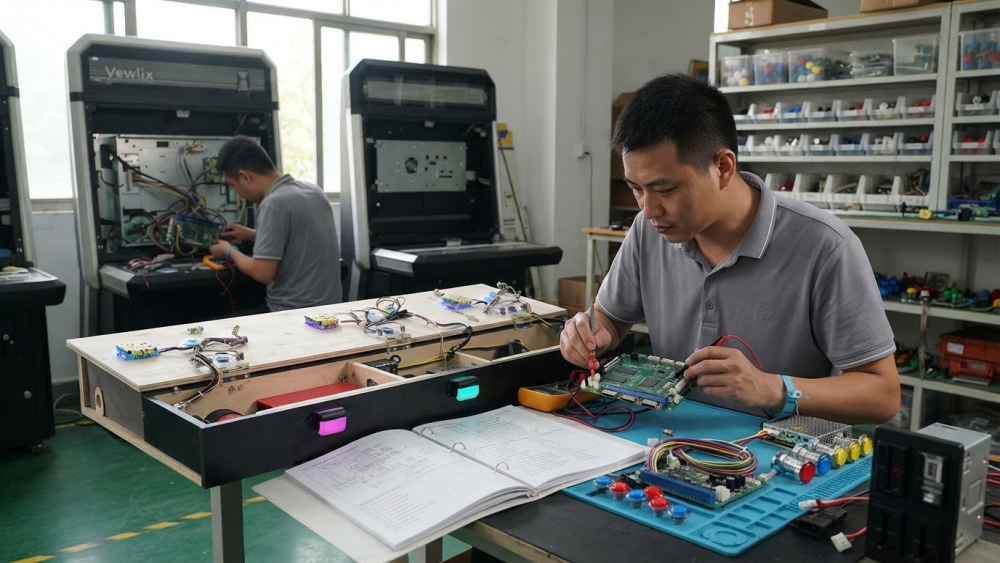
A replacement PCB is only useful when it matches the software, I/O board, screen, wiring harness, payment system, and player configuration already installed.
This is where some low-price purchases become expensive. A supplier may still offer a similar machine later, but the board, connector, software file, or payment settings may have changed.
For one venue, poor configuration records make repairs slower. For a distributor, every additional variation may require another board, harness, manual, software file, and spare-parts set.
Our guide to custom arcade machine production explains why hardware, software, payment, and cabinet changes should be confirmed before production.
Compare Quotations on the Same Basis
Two prices are only comparable when they include the same scope. A useful comparison should cover:
- Machine and customization price
- Packaging, freight, and local installation
- Voltage, payment, language, and software adaptation
- Included spare parts and technical records
- Warranty scope and support method
- Availability of matching replacement parts
- Pre-shipment testing and configuration confirmation
A higher quotation may still be the lower-cost purchase when it includes a tested configuration, useful spare parts, and continued technical support.
Industry Insight
Venue owners and distributors should not calculate ownership cost in the same way.
For a venue owner, the useful measure is cost per reliable operating day. A machine that costs slightly more but is easier to diagnose and repair may provide more usable operating time over its service life.
For a distributor, the hidden cost is configuration variety. Supporting ten machines with ten different boards, harnesses, software versions, and payment settings is often more expensive than supporting a standardized product line.
In long-term procurement, standardization is not simply a production convenience. It reduces spare-parts inventory, technician training, diagnostic time, and errors in repeat orders. Buyers should therefore negotiate for stable configurations and documented changes—not only a lower unit price.
Final Thoughts
The real cost of an arcade machine continues through transport, installation, adaptation, maintenance, downtime, and future replacement support.
The better machine is usually not the one with the lowest quotation. It is the one whose future costs are easier to predict and whose configuration can still be supported when the first repair or repeat order arrives.
Need Factory Direct Fish Game Solutions?
Contact FUSEN for fish game machines, PCB kits, cabinets, OEM/ODM customization, and long-term technical support.
Get Factory Quote