
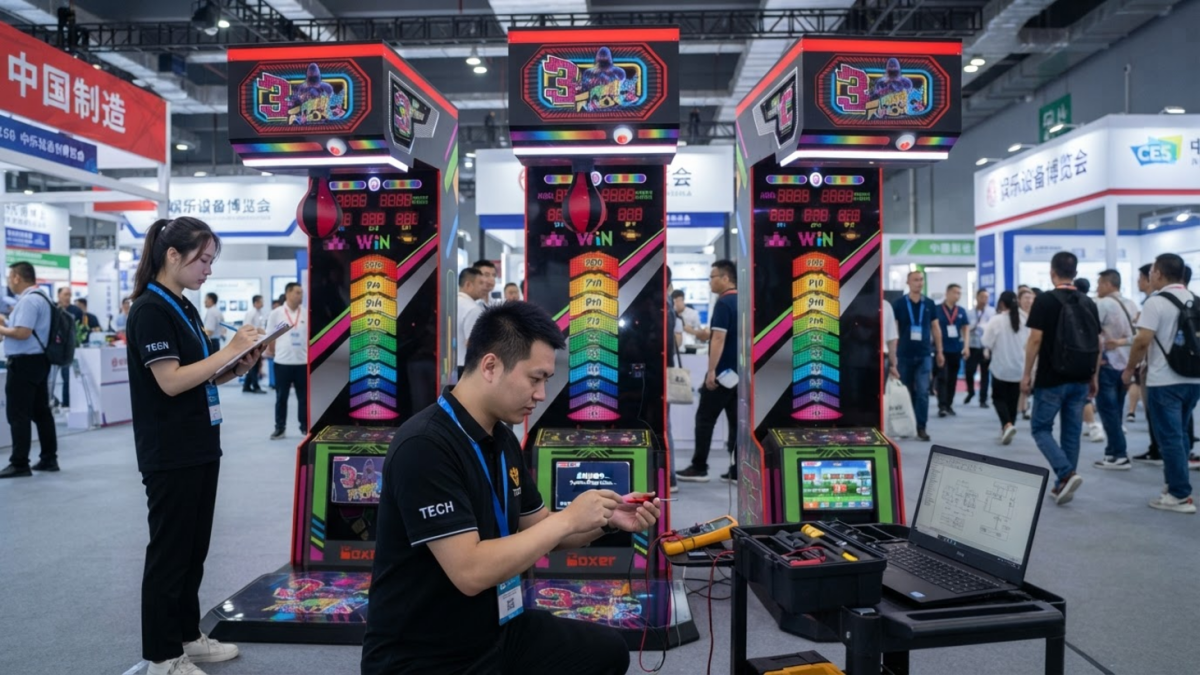
For game room owners and distributors, a boxing arcade machine is easy to attract attention. Players understand it quickly, the score creates competition, and people nearby often stop to watch.
But for commercial use, a punching arcade machine should not be judged only by lights, cabinet artwork, or price. The real value depends on cabinet stability, punching pad durability, sensor accuracy, scoring response, payment matching, maintenance access, and spare parts support.
Why Boxing Arcade Machines Work Well in Game Rooms
Boxing machines are suitable for arcades, shopping mall game rooms, family entertainment centers, and distributor showrooms because they create quick interaction. One player punches, the score appears, and the next player usually wants to try.
For operators, this kind of machine works best in open areas or high-traffic positions. It should support the venue’s customer flow, floor space, staff management, and maintenance plan. IAAPA’s Entertainment Center Benchmark Report covers attraction offerings, guest behavior, revenue generation, and expense management. You can refer to the IAAPA page on entertainment center benchmarks.
Cabinet Stability and Player Safety
A boxing arcade machine takes repeated impact every day. Some players will punch harder than expected, especially when competing with friends. This makes cabinet structure one of the first things buyers should check.
Before ordering, confirm the cabinet frame, base weight, punching arm structure, floor contact, side panels, front guard, and overall balance. Weak panels, loose parts, sharp edges, or poor stability can create problems after installation.

For distributors, cabinet consistency is also important. If each batch uses different internal parts or structure, later repair and spare parts support become harder.
Punching Pad, Sensor, and Scoring Response
The punching pad and sensor system are the core of an arcade punching machine. A machine may look strong from the outside, but if the score is unstable, players will lose trust quickly.
Buyers should check the punching pad material, rebound feel, sensor position, scoring board, display response, sound effect, and whether the machine can handle repeated impact. If the sensor is too sensitive, it may count false scores. If it is poorly positioned, strong punches may not register correctly.
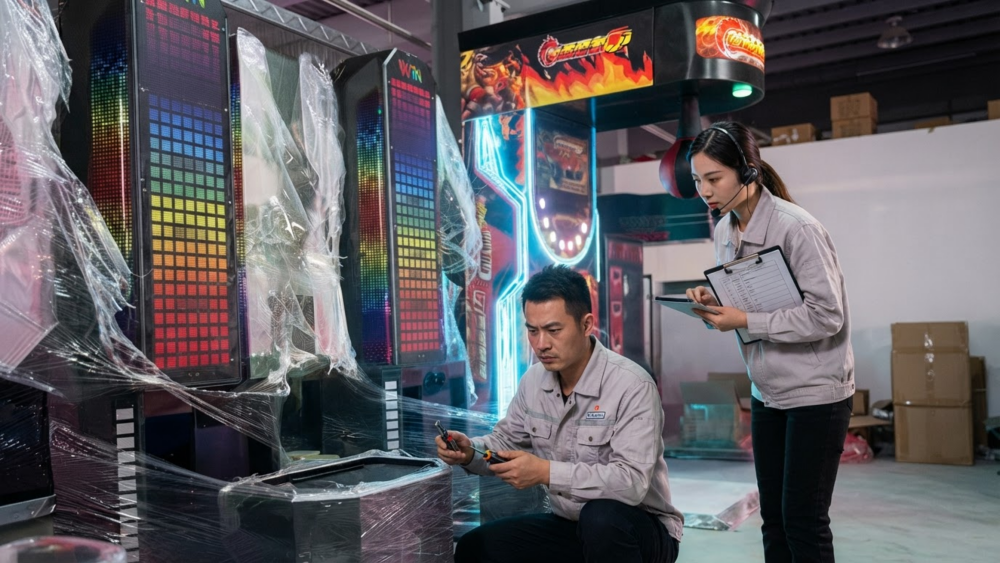
Repair buyers should send photos of the punching pad, sensor area, scoring board, control board, and wiring connector before ordering replacement parts. Many parts look similar but use different connectors or board logic.
Payment System and Control Board Matching
A boxing machine arcade game may use coin acceptors, card readers, bill acceptors, or mixed payment systems. These parts should match the control board, wiring harness, credit setting, and local operating method.
Payment habits are changing in many markets. The Federal Reserve’s 2025 Diary of Consumer Payment Choice reported that in 2024, cash accounted for 14% of U.S. consumer payments by number, while credit cards accounted for 35% and debit cards for 30%. You can review the Federal Reserve’s 2025 payment diary.
This does not mean every venue should stop using coins. It means buyers should choose the payment setup based on player habits, staff management, and machine configuration.
For related payment matching, our arcade card reader and coin acceptor guide explains why payment parts, wiring, I/O boards, and software settings should be checked together.
Maintenance Access and Electrical Parts
Inside the machine, buyers should check the control board, power supply, LED display, speaker, sensor cable, switch, wiring harness, and access door. A simple repair becomes slow if the inside layout is crowded or the wiring is not organized.
Electrical safety should also be considered for commercial equipment. UL 62368-1 applies to electrical and electronic equipment within the field of audio, video, information and communication technology. You can review the UL page on UL 62368-1 safety requirements.
For operators and repair buyers, the practical question is simple: can common parts be reached and replaced quickly after the machine is installed?
What Distributors Should Check Before Bulk Orders
Before bulk orders, distributors should confirm cabinet size, packed size, gross weight, voltage, plug type, payment method, spare parts list, logo options, packaging method, and test video.
It is also important to ask whether the supplier can continue providing the same punching pad, sensor, display board, control board, wiring accessories, power supply, and payment parts later.
For wider spare parts planning, our arcade machine parts buying guide gives a practical checklist for commercial game rooms.
Industry Insight
For venue owners, a boxing arcade machine should be judged by player response, uptime, and daily safety. A machine that attracts players but often has loose parts, sensor errors, or unstable scoring will quickly become a staff problem.
For distributors and repair buyers, the real value is stable structure, repeatable parts supply, clear wiring, and technical support. Experienced buyers do not only ask whether the machine looks powerful. They ask whether the punching pad, sensor, scoring board, payment system, control board, and spare parts can be supported over time.
Final Thoughts
Choosing a boxing arcade machine for commercial use should be treated as an equipment decision. Buyers should check cabinet stability, punching pad durability, sensor accuracy, scoring response, payment method, electrical parts, maintenance access, packaging, and spare parts supply before ordering.
The best machine is not only the one that looks strong. It is the one that keeps working, is easy to service, and supports long-term venue operation.
Need Factory Direct Fish Game Solutions?
Contact FUSEN for fish game machines, PCB kits, cabinets, OEM/ODM customization, and long-term technical support.
Get Factory Quote