
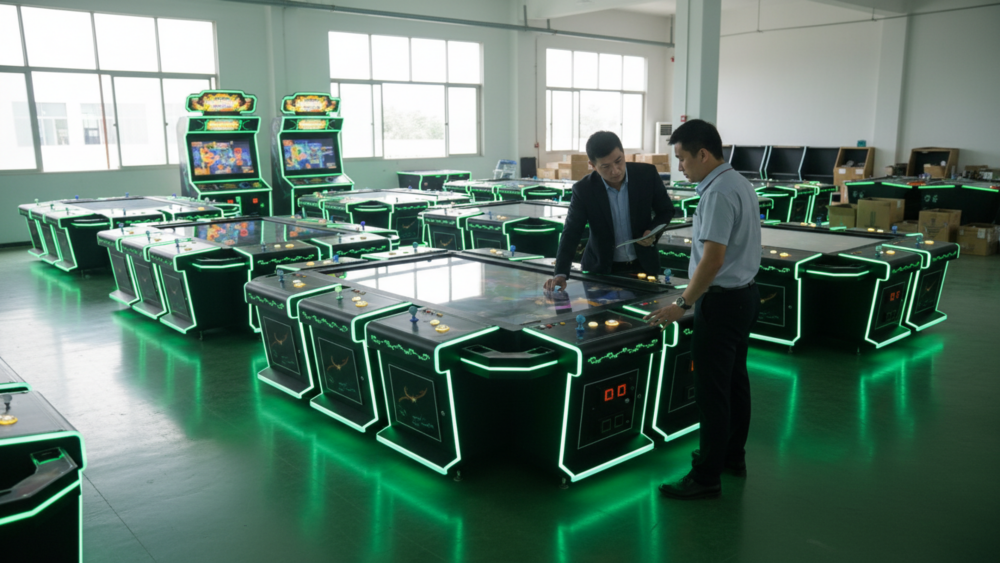
For most arcade operators, distributors, and game room investors, the first question is simple: how much does a fish game machine cost?
The honest answer is that there is no single fixed price. A fish game machine can be a PCB kit, a compact table, a 6-player cabinet, an 8-player fish table, or a customized commercial machine with different screens, software, cabinets, and payment systems.
In 2026, buyers should look at the total cost, not only the machine price. Cabinet size, PCB system, game software, accessories, packing, shipping, and after-sales support can all change the final quotation.
Quick Answer: What Is the Typical Price Range?
Public market listings show a wide price range for fish game machines and related equipment. Simple parts or I/O boards may cost only a few hundred dollars, while complete multiplayer fish tables and large commercial cabinets can range from several thousand dollars to much higher, depending on the configuration.
For example, public arcade equipment listings show fish game kits, 4-player cabinets, 8-player fish tables, and large fish machines at very different price levels. You can see this clearly from public references such as fish game equipment listings and commercial fish machine listings.
For a factory buyer, the better question is not “what is the cheapest machine?” but “what configuration fits my venue and operating plan?”
Main Factors That Affect Fish Game Machine Cost
1. PCB Kit or Complete Machine
A fish game PCB kit usually costs less than a complete machine because it does not include the cabinet, screen, control panel, power system, wiring, coin acceptor, bill acceptor, or packing materials.
This option is suitable for buyers who already have cabinets or local assembly capability. If you are comparing PCB options, you can also read our guide on how to choose the right fish game PCB kit.
A complete fish game machine costs more, but it is easier for new operators because the system is already assembled and tested before shipping.
 2. Number of Players
The number of player positions has a direct impact on cost. A 4-player machine usually uses a smaller cabinet and fewer control parts. A 6-player, 8-player, or 10-player fish table needs a larger frame, more buttons, more joysticks, more wiring, a stronger power system, and more testing time.
For commercial locations, larger machines may cost more at the beginning, but they can also support more players at the same time. That is why many arcade centers prefer 6-player or 8-player configurations.
3. Screen Size and Cabinet Structure
Screen size is one of the biggest hardware cost differences. A small upright cabinet and a large horizontal fish table are not in the same price range.
Cabinet material also matters. A stronger metal cabinet, better paint finish, reinforced control panel, and export-grade structure will usually cost more than a simple low-cost cabinet. For long-term operation, this difference is important because weak cabinets often lead to higher repair costs later.
4. Game Software and Stability
Fish game machines are not just hardware. The software system affects game stability, player experience, payout control, difficulty adjustment, and long-term operation.
A cheaper machine with unstable software may look attractive at first, but it can create problems after delivery: system crashes, control delay, poor screen output, unstable I/O communication, or difficult maintenance.
For serious buyers, software stability and technical support should be considered part of the real cost.
5. Accessories and Payment System
Different buyers need different accessories. A standard machine may include basic buttons, joysticks, wiring, speakers, power supply, and I/O board. Some buyers also need bill acceptors, ticket dispensers, card readers, special control panels, or customized language settings.
Every extra function can affect the final quotation. Before ordering, ask the supplier what is included in the standard price and what is optional.
Do Not Forget Shipping and Import Costs
Shipping is often the part buyers underestimate.
PCB kits and spare parts can often ship by express or air freight. Complete fish game machines usually need sea freight because of their size and weight. Ocean freight changes with routes, container demand, fuel cost, port conditions, and seasonal market movement. A freight benchmark such as the Freightos Baltic Index can help buyers understand that shipping cost is not fixed.
Import duties and local charges also need to be checked before ordering. For U.S. buyers, duty rates depend on product classification and import rules. Buyers can use official customs resources such as U.S. Customs and Border Protection duty rate guidance as a starting point, but the final confirmation should come from a customs broker or local import agent.
 Factory Price vs. Real Total Cost
A factory price is only one part of the total cost.
When comparing suppliers, buyers should check:
- Machine or PCB kit configuration
- Cabinet size and material
- Screen size and display output
- Game software version
- I/O board and wiring quality
- Included accessories
- Warranty period
- Remote technical support
- Packing method
- Shipping cost and delivery time
A low price is not always a better deal. If the supplier cannot provide stable software, proper testing, spare parts, or after-sales support, the real operating cost can become much higher.
How to Get an Accurate Fish Game Machine Quote
To get a reliable quotation, prepare the following information before contacting a manufacturer:
- Do you need a PCB kit or a complete machine?
- How many players do you need?
- What screen size or cabinet type do you prefer?
- Do you need coin acceptor, bill acceptor, or ticket output?
- Which country will the machine ship to?
- Do you need OEM branding or customized cabinet design?
The more details you provide, the more accurate the quotation will be. For buyers still comparing factories, you may also find our guide on how to choose a reliable fish game machine manufacturer in China useful.
Final Advice for Buyers
A fish game machine should not be judged by price alone. The best choice depends on your venue, budget, operating model, and long-term maintenance plan.
If you already have cabinets, a PCB kit may be the most cost-effective option. If you are opening a new arcade location, a complete machine may save time and reduce installation problems. If you are a distributor, factory-direct OEM or ODM service may give you better control over cabinet design, software options, and bulk pricing.
Before placing an order, compare the full configuration, not just the number on the quotation. A stable machine with proper testing and technical support is usually a better investment than the cheapest offer.
If you need factory pricing, PCB kit options, or a complete fish game machine quotation, contact Fusen Game for a configuration-based quote and game demo.
FAQ
How much does a fish game machine cost?
The cost depends on whether you buy a PCB kit, a compact cabinet, or a complete multiplayer fish table. Public listings show a wide range, from parts and boards at lower prices to complete commercial machines costing several thousand dollars or more.
Is a fish game PCB kit cheaper than a complete machine?
Yes. A PCB kit is usually cheaper because it does not include the cabinet, screen, control panel, wiring, and payment system. It is better for buyers who already have cabinets or assembly capability.
Why do fish game machine prices vary so much?
Prices vary because of cabinet size, number of players, screen configuration, PCB system, software, accessories, customization, packing, and shipping method.
Should I buy the cheapest fish game machine?
Not always. A very low price may mean weaker hardware, unstable software, poor testing, or limited support. For commercial use, stability and after-sales service are more important than the lowest price.
Need Factory Direct Fish Game Solutions?
Contact FUSEN for fish game machines, PCB kits, cabinets, OEM/ODM customization, and long-term technical support.
Get Factory Quote