
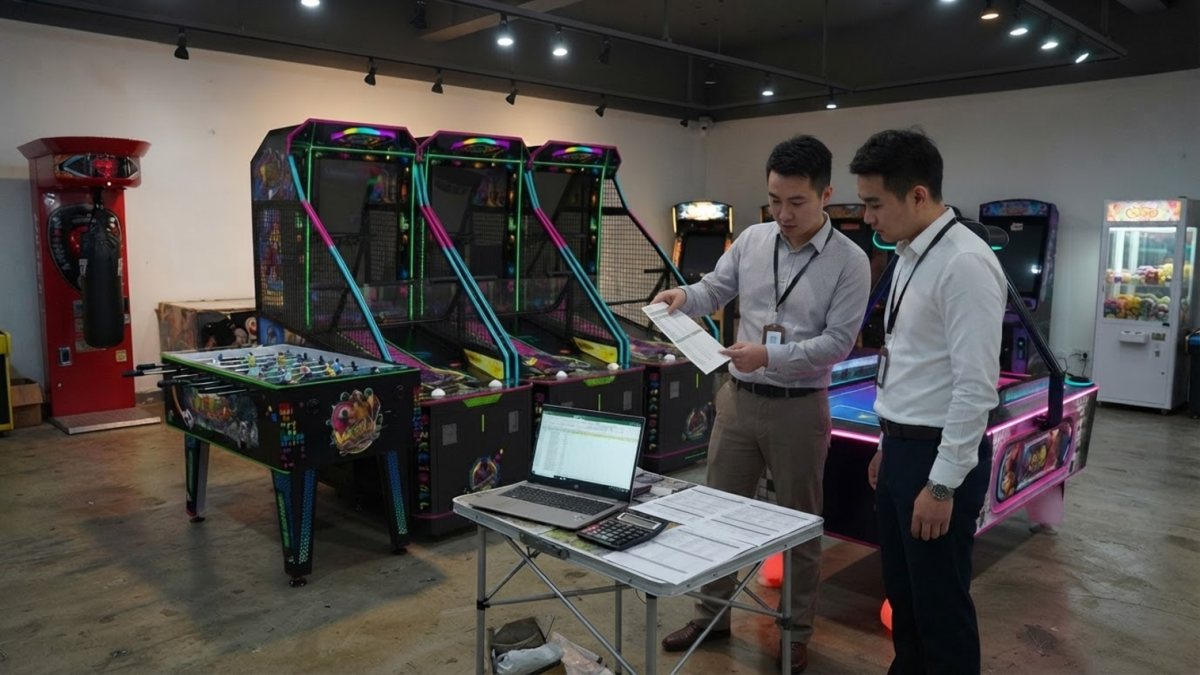
Asking how much an arcade machine costs sounds straightforward. In commercial purchasing, however, getting a price is easier than getting two prices that cover the same machine.
A compact cabinet may be listed near $1,000, while a large branded attraction can cost more than $10,000. Both may be described as arcade machines, even though their cabinets, screens, controls, software and service requirements are completely different.
For venue owners, distributors and repair purchasing teams, the useful question is not simply which machine is cheapest. It is what configuration, delivery scope and support are included in the quoted price.
How Much Does a Commercial Arcade Machine Cost?
There is no dependable industry-wide average. The term covers simple cabinet systems, children’s machines, sports equipment, multiplayer games and large licensed attractions.
The following public listings from one commercial equipment seller show the size of that range. They are reference examples, not Fusen quotations or fixed market averages.
| Public listing example | Listed price |
|---|---|
| 32-inch two-player metal arcade cabinet | $990 |
| Small children’s air hockey machine | $995–$1,195 |
| Selected four-player air hockey machines | About $1,895–$3,195 |
| Large branded air hockey attraction | Up to $11,895 |
The $990 cabinet listing includes a 32-inch monitor, two-player controls, JAMMA wiring and a game board. The same seller’s air hockey stock list shows how cabinet size, player capacity and brand positioning can move the price into a different category.
What Actually Changes the Price?
Two machines can look similar from the front and still be very different purchases.
Cabinet size affects metalwork, finishing and export packaging. Additional player positions require more controls, wiring and I/O connections. Screen quality, PCB or computer specification and software configuration also influence both the initial quotation and future replacement cost.
Commercial buyers should confirm at least five areas:
- Cabinet dimensions, materials and player capacity.
- Screen, PCB, software version and language.
- Coin acceptor, card reader and credit settings.
- Voltage, power supply, controls and internal wiring.
- Packaging, spare parts, testing and warranty support.
Before requesting prices, buyers should first decide which equipment fits the venue and customer group. Our commercial arcade machine buying guide covers that selection stage.
Compare the Scope Before Comparing the Price
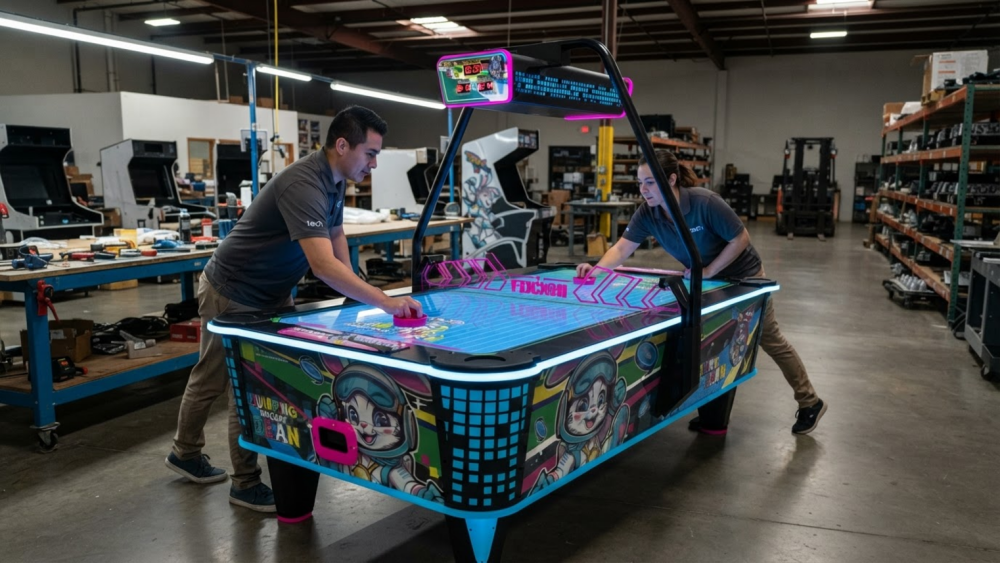
A low quotation is not automatically a poor quotation. It may simply exclude the payment hardware, export packing, spare parts or software work included by another supplier.
A workable quotation should state the machine dimensions, player count, screen, game system, voltage, payment interface, accessories, packing method, production time and warranty. Customized items should be separated into included, optional and excluded work.
This matters especially to distributors. A machine that cannot be reordered later with the same board, wiring and software may create more after-sales cost than the original price difference saved.
Our arcade machine supplier quotation guide explains how to compare offers using the same technical scope.
Factory Price Is Not the Delivered Cost
The delivery term should be written clearly on every quotation. A factory collection price and a quotation including export handling or international freight do not cover the same service.
Packed dimensions also matter. DHL Global Forwarding explains that carriers compare actual weight with volumetric weight and use the higher figure as the chargeable weight. Large cabinets can therefore be expensive to ship because of the space occupied by the machine and its protective packaging.
The public 32-inch cabinet page estimates about $600–$1,200 in freight-related costs for one unit, compared with roughly $150–$250 per unit for container orders. It is only one seller’s example, but it shows why small venue orders and distributor container orders can produce very different landed costs.
Request packed dimensions, gross weight, package quantity and estimated container loading before approving an order. Without those details, the delivered cost is still incomplete.

What Different Buyers Should Check
Venue owners should calculate the cost of putting the machine into operation, including local delivery, access restrictions, voltage adjustment and payment-system installation.
Distributors should check whether the same cabinet, software and components can be supplied again for repeat orders and after-sales support.
Repair purchasing teams should focus on internal compatibility. Common power supplies, buttons, readers, connectors and boards reduce spare-parts variety and make faults easier to diagnose.
Industry Insight
Many pricing problems begin before the supplier prepares the quotation. When the player count, payment system, voltage, software and packing requirements are unclear, each supplier fills the gaps differently.
The practical solution is to send every supplier the same requirement sheet and ask them to mark what is included, optional and excluded. Only then does the price comparison become meaningful.
A slightly higher unit price can be commercially sensible when it provides stable components, documented wiring and reliable replacement support. Our article on arcade machine total cost of ownership explains why these details continue to matter after delivery.
Final Thoughts
A commercial arcade machine may cost around $1,000 or rise above $10,000, but the number is useful only when the specification and delivery basis are clear. The best quotation is the one that shows exactly what will arrive, what remains excluded and whether the machine can be installed, maintained and reordered without creating additional problems later.
Need Factory Direct Fish Game Solutions?
Contact FUSEN for fish game machines, PCB kits, cabinets, OEM/ODM customization, and long-term technical support.
Get Factory Quote